 x
ad31cfbafa
Spike, not the final UI: it answers whether flare-ui can drive Alkane OS's
on-box pages, and what it costs.

What works:

- schema/alkane-bb.json authors the sidebar as data (3 sections, 14 tabs);
- src/bin/ui-spike.rs renders it through flare_ui::nav + flare_ui::shell, so
  the unified sidebar, ordering and surface filtering come from the schema
  rather than from hand-written HTML;
- the render uses the shared bf- design tokens, the same ones the rest of the
  suite uses.

Size, measured rather than assumed (armv7, release, stripped):

  ui-baseline   323 KiB   (maud + serde_json, no flare-ui)
  ui-spike      771 KiB   (flare-ui + wschema + sha2)
  marginal      448 KiB

Vendoring: third-party/flare-ui is the full v0.2.9 tree pinned in
flare-ui/flare-ui.lock (a partial archive does not compile, since the crate
include_str!s assets from dash-editor/). vendor/ is re-generated as a cargo
directory source with the new registry dependencies (maud, sha2, typenum,
digest, generic-array, block-buffer, crypto-common, cfg-if, etc.) so the build
still works offline. third-party/README.md records how to re-pin.
Żmij




Pure Rust implementation of Żmij, an algorithm to quickly convert floating point numbers to decimal strings.
This Rust implementation is a line-by-line port of Victor Zverovich's implementation in C++, https://github.com/vitaut/zmij.
Example
fn main() {
    let mut buffer = zmij::Buffer::new();
    let printed = buffer.format(1.234);
    assert_eq!(printed, "1.234");
}
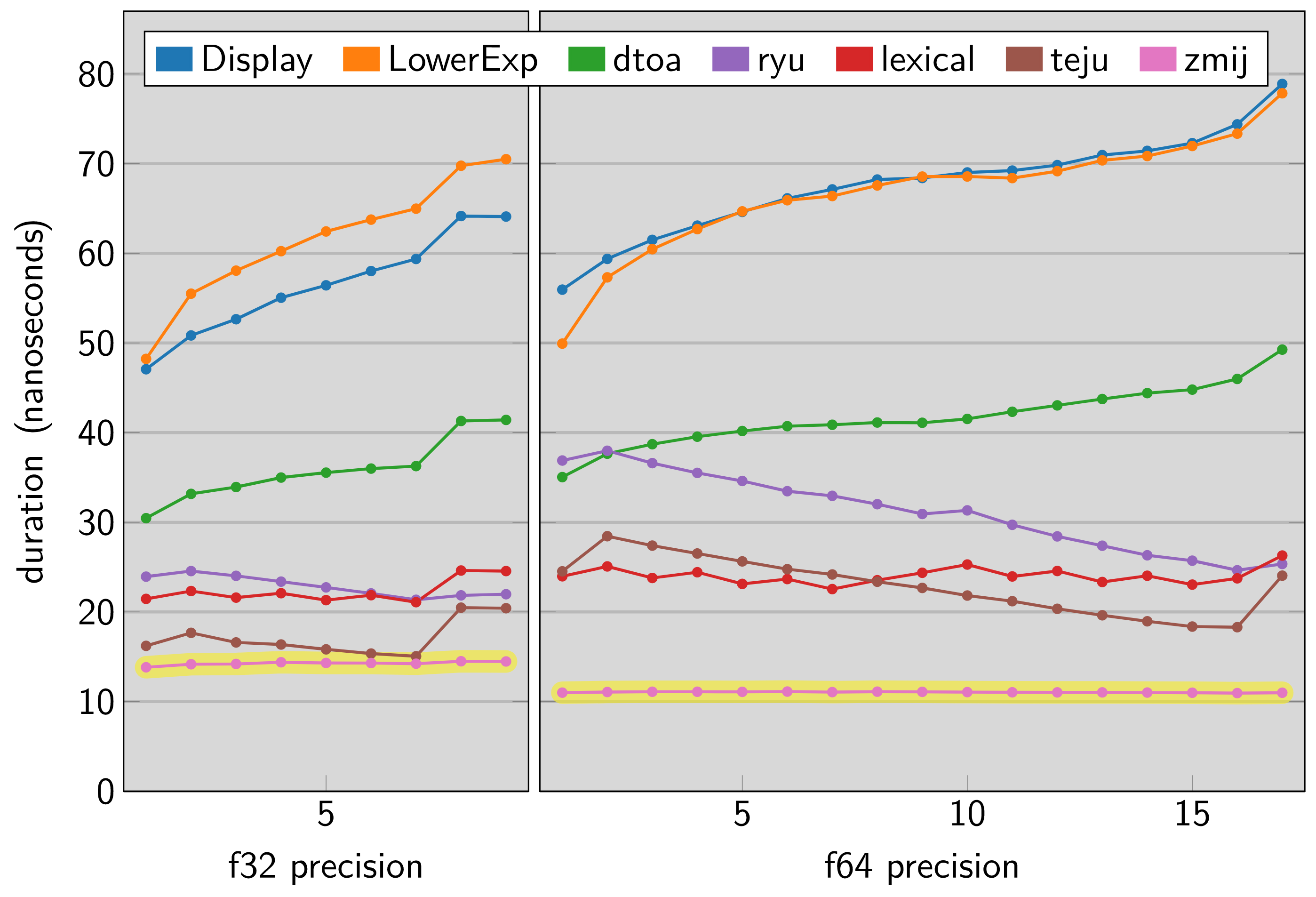
Performance
The dtoa-benchmark compares this library and other Rust floating point
formatting implementations across a range of precisions. The vertical axis in
this chart shows nanoseconds taken by a single execution of
zmij::Buffer::new().format_finite(value) so a lower result indicates a faster
library.