
232 lines
9.9 KiB
Markdown
232 lines
9.9 KiB
Markdown
# `simd_cesu8`   [![Build Status]][simd-cesu8] [![Crates.io Version]][crates-io] ![Crates.io MSRV]
|
|
|
|
[Build Status]: https://img.shields.io/github/actions/workflow/status/seancroach/simd_cesu8/ci.yml
|
|
|
|
[simd-cesu8]: https://github.com/seancroach/simd_cesu8
|
|
|
|
[Crates.io Version]: https://img.shields.io/crates/v/simd_cesu8
|
|
|
|
[crates-io]: https://crates.io/crates/simd_cesu8
|
|
|
|
[Crates.io MSRV]: https://img.shields.io/crates/msrv/simd_cesu8
|
|
|
|
An extremely fast, SIMD-accelerated, encoding and decoding library
|
|
for [CESU-8](https://en.wikipedia.org/wiki/UTF-8#CESU-8) and [Modified
|
|
UTF-8](https://en.wikipedia.org/wiki/UTF-8#Modified_UTF-8).
|
|
|
|
## Features
|
|
|
|
- Extremely fast encoding and decoding of CESU-8 and Modified UTF-8.
|
|
- Only allocates memory when absolutely necessary. Zero reallocations.
|
|
- Supports lossy decoding of CESU-8 and MUTF-8.
|
|
- Supports strict decoding of CESU-8 and MUTF-8.
|
|
- Up to 25 times faster than known alternatives when encoding.
|
|
- Up to 14 times faster than known alternatives when decoding.
|
|
- Supports AVX 2 and SSE 4.2 implementations on x86 and x86-64.
|
|
- ARM64 (aarch64) SIMD is supported.
|
|
- WASM (wasm32) SIMD is supported.
|
|
- PowerPC (powerpc) SIMD is (partially) supported.
|
|
- Falls back to word-at-a-time implementations instead of byte-at-a-time.
|
|
- No-std support.
|
|
|
|
## Usage
|
|
|
|
Add this to your `Cargo.toml` file:
|
|
|
|
```toml
|
|
[dependencies.simd_cesu8]
|
|
version = "1"
|
|
features = ["nightly"]
|
|
```
|
|
|
|
It is extremely recommended to use the nightly feature, as it enables the
|
|
fastest implementations of the library. If you don't want to use nightly, you
|
|
can remove the feature and the library will still work, but will be slower.
|
|
|
|
## Documentation
|
|
|
|
The documentation can be found on [docs.rs](https://docs.rs/simd_cesu8).
|
|
|
|
## MSRV
|
|
|
|
The minimum supported Rust version is 1.85.0.
|
|
|
|
## Benchmarks
|
|
|
|
These benchmarks were run with an AMD Ryzen 9 7950X3D on WSL2 with Rust
|
|
1.81.0-nightly. Each of the operations were measured with an input exactly equal
|
|
to 16,380 bytes. Data sets were randomly generated with the same seed for each
|
|
operation. Each set contained 1,000 values, that were endlessly repeated as
|
|
input. The benchmarks were run with the [`criterion`] crate. The tables got
|
|
created via [`critcmp`]. The source code for the benchmarks can be found in the
|
|
`benches` directory. Any call to `simd_cesu8` was replaced with the `cesu8`
|
|
equivalent when collecting the data for the `cesu8` benchmarks. The data
|
|
collected can also be found in the `benches` directory.
|
|
|
|
We compare `simd_cesu8` to the [`cesu8`] library, as it's the most popular
|
|
library for CESU-8 and MUTF-8 encoding and decoding in Rust. I originally
|
|
started this project, however, because there's a few minor semantic errors in
|
|
the `cesu8` library that I wanted to fix myself.
|
|
|
|
[`criterion`]: https://github.com/bheisler/criterion.rs
|
|
|
|
[`critcmp`]: https://github.com/BurntSushi/critcmp
|
|
|
|
### Encoding
|
|
|
|
To understand the benchmarks, it's first a good idea to familiarize yourself
|
|
with the datasets used to benchmark the encoding operations:
|
|
|
|
- `ascii_non_null_strings` are strings exactly 16,380 bytes long with only ASCII
|
|
characters and no null bytes.
|
|
- `ascii_null_alternating_strings` are strings exactly 16,380 bytes long with
|
|
only ASCII characters and null bytes alternating, where every odd byte is
|
|
non-null and every even byte is null.
|
|
- `interspersed_strings` are strings exactly 16,380 bytes long with every 20
|
|
bytes in the following pattern:
|
|
- A non-null ASCII character (1 byte)
|
|
- A 2-byte UTF-8 character
|
|
- A 3-byte UTF-8 character
|
|
- A 4-byte UTF-8 character
|
|
- A null byte
|
|
- A 2-byte UTF-8 character
|
|
- A 3-byte UTF-8 character
|
|
- A 4-byte UTF-8 character
|
|
- `null_strings` are strings exactly 16,380 bytes long with only null bytes.
|
|
- `utf8_clamped_width_2_strings` are strings exactly 16,380 bytes long with only
|
|
2-byte UTF-8 characters.
|
|
- `utf8_clamped_width_3_strings` are strings exactly 16,380 bytes long with only
|
|
3-byte UTF-8 characters.
|
|
- `utf8_clamped_width_4_strings` are strings exactly 16,380 bytes long with only
|
|
4-byte UTF-8 characters.
|
|
|
|
#### `simd_cesu8::encode`
|
|
|
|
|
|
|
|
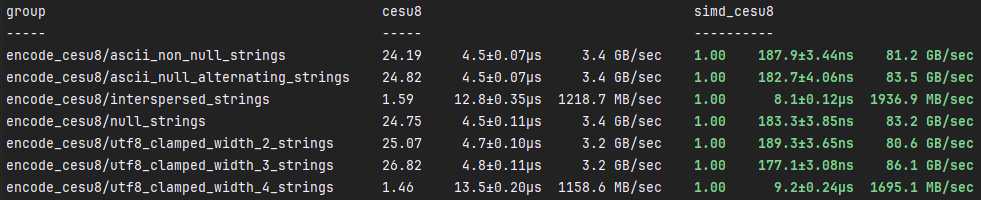
`simd_cesu8::encode` is around %2,500 faster than `cesu8::to_cesu8` in optimal
|
|
conditions. In suboptimal conditions, `simd_cesu8::encode` is around %50 faster
|
|
than `cesu8::to_cesu8`. The main reason for the speedup, beyond SIMD, is
|
|
that `simd_cesu8` doesn't quickly check for just ASCII characters, but instead,
|
|
it checks for the start of 4-byte characters. This is a significant speedup over
|
|
the traditional ASCII hot paths. Other speedups come in the form of cumulative,
|
|
tiny optimizations that add up to a significant speedup.
|
|
|
|
#### `simd_cesu8::mutf8::encode`
|
|
|
|
|
|
|
|
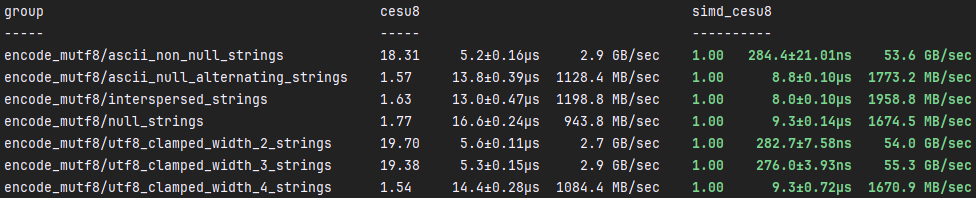
Similar to `simd_cesu8::encode`, `simd_cesu8::mutf8::encode` is around %1800
|
|
faster than `cesu8::to_java_cesu8` in optimal conditions. In suboptimal
|
|
conditions, `simd_cesu8::mutf8::encode` is around %50 faster than
|
|
`cesu8::to_java_cesu8`. The same reason for the speedup applies here, but
|
|
instead of checking for the start of 4-byte characters, we're also checking for
|
|
any null bytes with SIMD. Other speedups come in the form of cumulative, tiny
|
|
optimizations that add up to a significant speedup.
|
|
|
|
### Decoding
|
|
|
|
To understand the benchmarks, it's first a good idea to familiarize yourself
|
|
with the datasets used to benchmark the decoding operations:
|
|
|
|
- `ascii_non_null_bytes` is a set of UTF-8 strings exactly 16,380 bytes long
|
|
with only ASCII characters and no null bytes.
|
|
- `ascii_null_alternating_bytes` is a set of UTF-8 strings exactly 16,380 bytes
|
|
long with only ASCII characters and null bytes alternating, where every odd
|
|
byte is non-null and every even byte is null.
|
|
- `interspersed_bytes` is a set of UTF-8 strings exactly 16,380 bytes long with
|
|
every 20 bytes in the following pattern:
|
|
- A non-null ASCII character (1 byte)
|
|
- A 2-byte UTF-8 character
|
|
- A 3-byte UTF-8 character
|
|
- A 4-byte UTF-8 character
|
|
- A null byte
|
|
- A 2-byte UTF-8 character
|
|
- A 3-byte UTF-8 character
|
|
- A 4-byte UTF-8 character
|
|
- `interspersed_cesu8_bytes` is a set of CESU-8 strings exactly 16,380 bytes
|
|
long with every 12 bytes in the following pattern:
|
|
- An ASCII character (1 byte)
|
|
- A 2-byte UTF-8 character
|
|
- A 3-byte UTF-8 character
|
|
- A 4-byte UTF-8 character encoded as a surrogate pair (6 bytes)
|
|
- `interspersed_mutf8_bytes` is a set of MUTF-8 strings exactly 16,380 bytes
|
|
long with every 26 bytes in the following pattern:
|
|
- A non-null ASCII character (1 byte)
|
|
- A non-null ASCII character (1 byte)
|
|
- A 2-byte UTF-8 character
|
|
- A 3-byte UTF-8 character
|
|
- A 4-byte UTF-8 character encoded as a surrogate pair (6 bytes)
|
|
- A null byte encoded as a 2-byte sequence
|
|
- A 2-byte UTF-8 character
|
|
- A 3-byte UTF-8 character
|
|
- A 4-byte UTF-8 character encoded as a surrogate pair (6 bytes)
|
|
- `mutf8_null_bytes` is a set of MUTF-8 strings exactly 16,380 bytes long with
|
|
only null encoded as a 2-byte sequence.
|
|
- `null_bytes` is a set of UTF-8 strings exactly 16,380 bytes long with only
|
|
null bytes.
|
|
- `surrogate_pairs_bytes` is a set of CESU-8 strings exactly 16,380 bytes long
|
|
with only 6-byte surrogate pairs.
|
|
- `utf8_clamped_width_2_bytes` is a set of UTF-8 strings exactly 16,380 bytes
|
|
long with only 2-byte UTF-8 characters.
|
|
- `utf8_clamped_width_3_bytes` is a set of UTF-8 strings exactly 16,380 bytes
|
|
long with only 3-byte UTF-8 characters.
|
|
- `utf8_clamped_width_4_bytes` is a set of UTF-8 strings exactly 16,380 bytes
|
|
long with only 4-byte UTF-8 characters.
|
|
|
|
#### `simd_cesu8::decode`
|
|
|
|
|
|
|
|
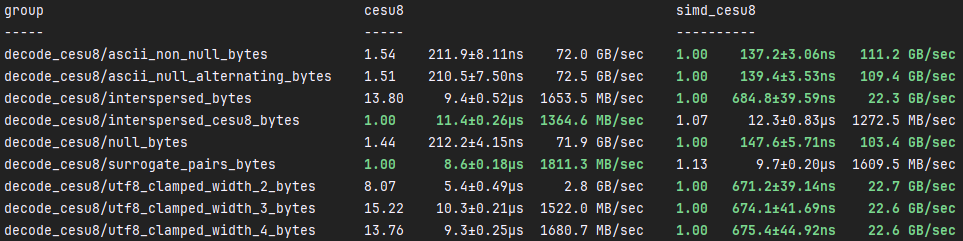
In optimal conditions, `simd_cesu8::decode` can be around %1,400 faster than
|
|
`cesu8::to_cesu8`. However, `simd_cesu8::decode` is slower
|
|
than `cesu8::to_cesu8` when decoding surrogate pairs. The main reason is
|
|
that `simd_cesu8` supports lossy decoding, but the internals of that seems to
|
|
introduce a decent amount of overhead. `simd_cesu8` is faster in all ways
|
|
that `cesu8` **when LTO is enabled**. However, I didn't run the benchmarks with
|
|
LTO enabled because it seems disingenuous to do so as LTO shouldn't be a
|
|
requirement for a library to be fast.
|
|
|
|
#### `simd_cesu8::mutf8::decode`
|
|
|
|
|
|
|
|
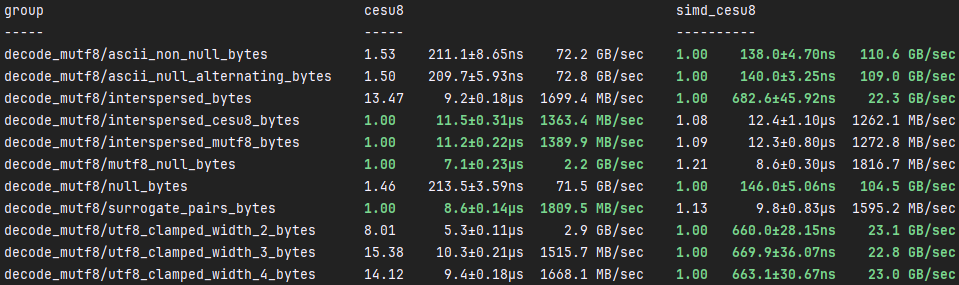
Much like `simd_cesu8::decode`, `simd_cesu8::mutf8::decode` can be around %1,400
|
|
faster than `cesu8::to_java_cesu8`. But, the pitfalls are equally the same, as
|
|
`simd_cesu8::mutf8::decode` is slower than `cesu8::to_java_cesu8` when decoding
|
|
surrogate pairs. The other catch is that we're slightly slower than `cesu8` when
|
|
decoding null bytes. The same reasoning applies here, as the overhead is higher.
|
|
|
|
## Thanks
|
|
|
|
- To the authors of the [`cesu8`] library. It's a genuinely good library that
|
|
helped me years ago learn some more complex Rust concepts.
|
|
- To the authors of [`simdutf8`] for arguably one of the biggest improvements to
|
|
the borrow paths in this library.
|
|
- To the authors of [`simdnbt`] for the inspiration of using `portable_simd`.
|
|
|
|
[`cesu8`]: https://github.com/emk/cesu8-rs/
|
|
|
|
[`simdutf8`]: https://github.com/rusticstuff/simdutf8
|
|
|
|
[`simdnbt`]: https://github.com/azalea-rs/simdnbt
|
|
|
|
## License
|
|
|
|
Licensed under either of
|
|
|
|
- Apache License, Version 2.0
|
|
([LICENSE-APACHE](https://github.com/seancroach/simd_cesu8/blob/main/LICENSE-APACHE)
|
|
or <http://www.apache.org/licenses/LICENSE-2.0>)
|
|
- MIT license
|
|
([LICENSE-MIT](https://github.com/seancroach/simd_cesu8/blob/main/LICENSE-MIT)
|
|
or <http://opensource.org/licenses/MIT>)
|
|
|
|
at your option.
|
|
|
|
## Contribution
|
|
|
|
Unless you explicitly state otherwise, any contribution intentionally submitted
|
|
for inclusion in the work by you, as defined in the Apache-2.0 license, shall be
|
|
dual licensed as above, without any additional terms or conditions.
|